

Allegory In Young Goodman Brown
| Young Goodman Brown | |
|---|---|
| past Nathaniel Hawthorne | |
 | |
| Country | United States |
| Language | English language |
| Published in | Mosses from an Erstwhile Manse |
| Publication engagement | 1835 (anonymously) in The New-England Mag; 1846 (under his own name) in Mosses from an Old Manse |
"Young Goodman Chocolate-brown" is a short story published in 1835 past American writer Nathaniel Hawthorne. The story takes place in 17th-century Puritan New England, a common setting for Hawthorne'southward works, and addresses the Calvinist/Puritan belief that all of humanity exists in a state of depravity, but that God has destined some to unconditional ballot through unmerited grace. Hawthorne frequently focuses on the tensions within Puritan civilisation, however steeps his stories in the Puritan sense of sin. In a symbolic fashion, the story follows Young Goodman Brown's journey into cocky-scrutiny, which results in his loss of virtue and belief.[one]
Plot [edit]
The story begins at dusk in Salem Hamlet, Massachusetts every bit young Goodman Brown leaves Religion, his wife of three months, for some unknown errand in the forest. Organized religion pleads with her hubby to stay with her, only he insists that the journey must be completed that night. In the forest he meets an older man, dressed in a similar manner and bearing a physical resemblance to himself. The man carries a blackness ophidian-shaped staff. Deeper in the forest, the ii encounter Goody Cloyse, an older woman, whom Immature Goodman had known every bit a boy and who had taught him his catechism. Cloyse complains about the need to walk; the older human throws his staff on the ground for the woman and quickly leaves with Brown.
Other townspeople inhabit the woods that night, traveling in the same direction every bit Goodman Brownish. When he hears his wife'south voice in the trees, he calls out merely is not answered. He then runs angrily through the forest, distraught that his beautiful Faith is lost somewhere in the dark, sinful forest. He soon stumbles upon a clearing at midnight where all the townspeople assembled. At the anniversary, which is carried out at a flame-lit altar of rocks, the newest acolytes are brought forth—Goodman Brown and Faith. They are the only two of the townspeople non yet initiated. Goodman Brown calls to sky and Faith to resist and instantly the scene vanishes. Arriving dorsum at his home in Salem the adjacent morning, Goodman Brown is uncertain whether the previous night'due south events were real or a dream, but he is securely shaken, and his belief he lives in a Christian community is distorted. He loses his organized religion in his wife, along with all of humanity. He lives his life an embittered and suspicious cynic, wary of anybody around him. The story concludes: "And when he had lived long, and was borne to his grave... they carved no hopeful poesy upon his tombstone, for his dying hour was gloom."
Development and publication history [edit]
The story is set during the Salem witch trials, at which Hawthorne'southward great-great-granddad John Hathorne was a judge, guilt over which inspired the writer to modify his family'south name, calculation a "w" in his early twenties, shortly after graduating from college.[2] In his writings Hawthorne questioned established idea—most specifically New England Puritanism and contemporary Transcendentalism. In "Immature Goodman Brown", as with much of his other writing, he utilizes ambiguity.[3]
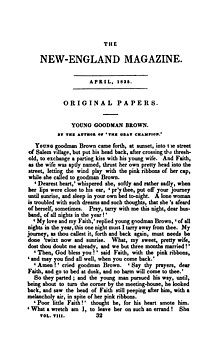
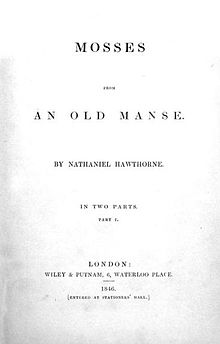
"Young Goodman Brownish" was first published in the Boston-based The New-England Mag in its April 1835 issue. It did non include Hawthorne's proper name and was instead credited "past the author of 'The Gray Champion'".[4] It was finally published with the writer's name in Mosses from an Old Manse in 1846.
Assay [edit]
Interpretation of Evil Human Nature [edit]
"Immature Goodman Brown" is often characterized every bit an allegory virtually the recognition of evil and depravity as the nature of humanity.[5] Much of Hawthorne's fiction, such as The Scarlet Letter, is ready in 17th-century colonial America, peculiarly Salem Hamlet. Language of the flow is used to enhance the setting. Hawthorne gives the characters specific names that describe abstract pure and wholesome behavior, such as "Young Goodman Chocolate-brown" and "Faith". The characters' names ultimately serve equally a paradox in the conclusion of the story. The inclusion of this technique was to provide a definite contrast and irony. Hawthorne aims to critique the ideals of Puritan gild and express his disdain for information technology, thus illustrating the deviation between the appearance of those in society and their true identities.[6] [seven] [eight]
Literary scholar Walter Shear writes that Hawthorne structured the story in three parts. The first part shows Goodman Brown at his home in his hamlet integrated in his gild. The second part of the story is an extended dreamlike/nightmare sequence in the forest for a single nighttime. The 3rd part shows his return to society and to his home, yet he is so profoundly changed that in rejecting the greeting of his married woman Faith, Hawthorne shows Goodman Brown has lost faith and rejected the tenets of his Puritan globe during the class of the night.[9]
The story is almost Brown'due south loss of faith as one of the elect, co-ordinate to scholar Jane Eberwein. Believing himself to be of the elect, Goodman Brownish falls into cocky-dubiousness afterwards iii months of wedlock which to him represents sin and depravity as opposed to salvation. His journey to the forest is symbolic of Christian "self-exploration" in which uncertainty immediately supplants faith. At the end of the forest experience he loses his wife Faith, his faith in conservancy, and his religion in human goodness.[6]
Estimation of Impossible Perfection [edit]
One estimation of the text is every bit an apologue to emphasize how perfection as impossible, through interactions in the forest. The writer introduces the shadowy figure as an "elder person as simply clad equally a younger, [with] an indescribable air of one who knew the earth". The writer depicts this evil figure as non only like to Goodman Brown, but also more educated in his historic period. After establishing the dark figure's legitimacy, he delivers a message that only the young and naïve believe that perfection can exist achieved. The devil claims to have helped his father "set burn to an Indian village, in King Philip'due south war." By shattering Young Goodman Brown's conception that his fathers were paragons of Puritan ideals, Young Goodman Brown began his slow descent until his "dying hour of gloom," setting upwardly a perspective that perfection is just an illusion past showing how believers set themselves up for a sorry death. Similarly, the futility of perfection can also be ascertained at the final Devil meeting. The showtime thing Goodman Brown hears when he arrives is "a familiar [tune] in the choir of the village meetinghouse." This comparison brings to heed a setting in which the piety and perfection preached past the church contrasts the reality of human imperfection.[10] Truthful to its set, the dark sable figure presumed to be the devil delivers a conversion spoken language for the Goodman Dark-brown by lecturing how Puritans "shrank from your own sin, contrasting it with their lives of righteousness and prayerful aspirations heavenward.... This night it shall be granted yous to know their secret deeds: how hoary-bearded elders of the church have whispered wanton words to the young maids of their households." By highlighting the "wanton words" and "surreptitious deeds" that Puritans muffle in fearfulness of being found out,[11] the devil elucidates the hypocrisy that the Puritans middle their life upon; indeed, Young Goodman Brown's world shatters when he realizes that what appears to exist "lives of righteousness" are actually tainted past awful sin. Overall, the shadowy figure and the aureola of the final demon coming together can imply an estimation that perfection is simply a myth, and those in pursuit of information technology do so out of naivety of reality.
Literary significance and reception [edit]
Herman Melville said "Young Goodman Brown" was "as deep equally Dante" and Henry James called information technology a "magnificent little romance".[12] Hawthorne himself believed the story made no more than impact than whatsoever of his tales. Years later he wrote, "These stories were published... in Magazines and Annuals, extending over a period of x or twelve years, and comprising the whole of the writer'south immature manhood, without making (so far every bit he has ever been enlightened) the slightest impression on the public".[13] Gimmicky critic Edgar Allan Poe disagreed, referring to Hawthorne'due south short stories equally "the products of a truly imaginative intellect".[fourteen]
Stephen Male monarch has referred to "Young Goodman Chocolate-brown" as "1 of the ten best stories written by an American". He calls information technology his favorite story by Hawthorne and cites it as an inspiration for his O. Henry Award-winning brusque story, "The Man in the Black Arrange".[xv]
Adaptations [edit]
A 1972 brusque film directed by Donald Fox is based on the story. It features actors Marking Bramhall, Peter Kilman, and Maggie McOmie.
In 1982, the story was adapted for the CBC radio programme Nightfall.
This is the only work of Hawthorne's included in the Library of America'southward 2009 anthology American Fantastic Tales: Terror and the Uncanny from Poe to the Pulps.
In 2011, playwright Lucas (Luke) Krueger, adapted the story for the stage. It was produced by Northern Illinois University. In 2012, Playscripts Inc. published the play. It has since been produced by several companies and high schools.
The 2015 music video for the Brandon Flowers vocal "Can't Deny My Dearest" is based on Hawthorne's story, with Flowers starring as the Goodman Brown effigy and Evan Rachel Wood as his wife.
Comic artist Kate Beaton satirized the story in a serial of comic strips for her webcomic Hark! A Vagrant, which focuses on mocking Goodman Brownish'southward obsessive, black-and-white morality and his hypocrisy toward his wife and friends.[16]
References [edit]
- ^ Summary of Young Goodman Brown, articlemyriad.com; accessed Dec 23, 2014.
- ^ McFarland, Philip. Hawthorne in Hold. New York: Grove Press, 2004: xviii. ISBN 978-0-8021-1776-2.
- ^ Gray, Richard. A History of American Literature. p. 200
- ^ Brown, Nina E. A Bibliography of Nathaniel Hawthorne. Boston and New York: Houghton, Mifflin and Visitor, 1905: 57.
- ^ Bell, Michael Davitt. Hawthorne and the Historical Romance of New England. Princeton, New Bailiwick of jersey: Princeton Academy Printing, 1971, p. 77; ISBN 978-0-691-06136-8
- ^ a b Eberwein, Jane Donahue. "My Faith is Gone! 'Young Goodman Dark-brown' and Puritan conversion", Nathaniel Hawthorne's Young Goodman Brown (2005). Bloom, Harold, (ed.) Chelsea House; ISBN 978-0-7910-8124-two, pp. 20–27.
- ^ Easterly, Joan Elizabeth. "Lachrymal Imagery in Hawthorne'due south 'Young Goodman Dark-brown'", Studies in Curt Fiction 28, no. 3 (Summertime 1991). Quoted as "Lachrymal Imagery in Hawthorne's 'Young Goodman Dark-brown'", Flower's Modern Critical Interpretations. New York: Chelsea Firm Publishing, 2005. Bloom'due south Literary Reference Online
- ^ Mayr, Julia Gaunce; Gaunce, Suzette (2004). The Broadview Album of Short Fiction. Peterborough: Broadview Press.
- ^ Shear, Walter. "Cultural Fate and Social Freedom in Three American Brusk Stories", Nathaniel Hawthorne's Young Goodman Brown (2005). Flower, Harold (ed.), Chelsea Business firm; ISBN 978-0-7910-8124-ii, pp. 63–66.
- ^ Brauer, Jerald C. (March 1987). "Types of Puritan Piety". Church History. 56 (one): 39–58. doi:10.2307/3165303. ISSN 1755-2613.
- ^ "Puritanism | Definition, History, Beliefs, & Facts | Britannica". www.britannica.com . Retrieved 2021-11-11 .
- ^ Miller, Edwin Haviland. Salem Is My Habitation Identify: A Life of Nathaniel Hawthorne. Iowa City: University of Iowa Press, 1991: 119; ISBN 978-0-87745-332-i.
- ^ McFarland, Philip. Hawthorne in Concord. New York: Grove Printing, 2004: 22. ISBN 978-0-8021-1776-ii.
- ^ Quinn, Arthur Hobson. Edgar Allan Poe: A Disquisitional Biography. Baltimore: The Johns Hopkins Academy Press, 1998: 334; ISBN 978-0-8018-5730-0.
- ^ King, Stephen. Everything'south Eventual. New York: Pocket Books, 2007: pp. 69–70
- ^ harkavagrant.com
External links [edit]

Wikisource has original text related to this article:
-
 Media related to Young Goodman Brown at Wikimedia Eatables
- Immature Goodman Brown at Project Gutenberg
- Reading of Young Goodman Brown by Stuff Y'all Should Read Podcast
-
 Immature Goodman Brown public domain audiobook at LibriVox

Allegory In Young Goodman Brown,
Source: https://en.wikipedia.org/wiki/Young_Goodman_Brown
Posted by: foxarned2000.blogspot.com
0 Response to "Allegory In Young Goodman Brown"
Post a Comment