

3.6 As A Improper Fraction

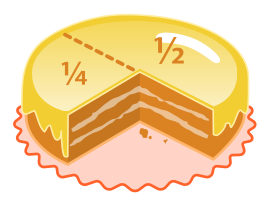
A block with one quarter (one fourth) removed. The remaining iii fourths are shown by dotted lines and labeled by the fraction 1 / 4
A fraction (from Latin: fractus, "broken") represents a office of a whole or, more generally, any number of equal parts. When spoken in everyday English, a fraction describes how many parts of a certain size there are, for example, one-one-half, eight-fifths, three-quarters. A common, vulgar, or simple fraction (examples: and ) consists of a numerator, displayed higher up a line (or before a slash like 1⁄2 ), and a non-zero denominator, displayed below (or later) that line. Numerators and denominators are also used in fractions that are not mutual, including compound fractions, complex fractions, and mixed numerals.


In positive common fractions, the numerator and denominator are natural numbers. The numerator represents a number of equal parts, and the denominator indicates how many of those parts brand up a unit of measurement or a whole. The denominator cannot exist goose egg, considering cypher parts can never make upwards a whole. For instance, in the fraction 3 / 4 , the numerator 3 indicates that the fraction represents 3 equal parts, and the denominator 4 indicates that 4 parts make up a whole. The pic to the right illustrates 3 / four of a block.
A common fraction is a numeral which represents a rational number. That same number can also be represented every bit a decimal, a pct, or with a negative exponent. For instance, 0.01, i%, and x−2 are all equal to the fraction 1/100. An integer can be idea of as having an implicit denominator of ane (for example, 7 equals seven/1).
Other uses for fractions are to stand for ratios and partition.[ane] Thus the fraction 3 / iv can also be used to represent the ratio 3:four (the ratio of the part to the whole), and the division three ÷ 4 (iii divided by four). The not-zero denominator dominion, which applies when representing a division as a fraction, is an instance of the rule that division by zero is undefined.
We can as well write negative fractions, which correspond the opposite of a positive fraction. For example, if 1 / 2 represents a half-dollar profit, then − 1 / 2 represents a half-dollar loss. Because of the rules of sectionalisation of signed numbers (which states in part that negative divided by positive is negative), − 1 / ii , −ane / two and ane / −2 all stand for the aforementioned fraction – negative one-one-half. And considering a negative divided by a negative produces a positive, −1 / −two represents positive ane-half.
In mathematics the prepare of all numbers that can be expressed in the course a / b , where a and b are integers and b is non zero, is called the set of rational numbers and is represented by the symbol Q, which stands for quotient. A number is a rational number precisely when it can be written in that grade (i.e., as a common fraction). However, the give-and-take fraction can as well be used to describe mathematical expressions that are not rational numbers. Examples of these usages include algebraic fractions (quotients of algebraic expressions), and expressions that incorporate irrational numbers, such as (come across square root of ii) and π / four (run across proof that π is irrational).

Vocabulary [edit]
In a fraction, the number of equal parts being described is the numerator (from Latin: numerātor, "counter" or "numberer"), and the blazon or multifariousness of the parts is the denominator (from Latin: dēnōminātor, "thing that names or designates").[2] [3] As an example, the fraction 8 / 5 amounts to eight parts, each of which is of the type named "fifth". In terms of partition, the numerator corresponds to the dividend, and the denominator corresponds to the divisor.
Informally, the numerator and denominator may be distinguished by placement lone, but in formal contexts they are usually separated by a fraction bar. The fraction bar may exist horizontal (as in 1 / 3 ), oblique (as in 2/5), or diagonal (as in four⁄9 ).[4] These marks are respectively known every bit the horizontal bar; the virgule, slash (U.s.a.), or stroke (UK); and the fraction bar, solidus,[5] or fraction slash.[n 1] In typography, fractions stacked vertically are also known as "en" or "nut fractions", and diagonal ones as "em" or "mutton fractions", based on whether a fraction with a single-digit numerator and denominator occupies the proportion of a narrow en square, or a wider em square.[4] In traditional typefounding, a piece of type begetting a consummate fraction (eastward.chiliad. 1 / 2 ) was known as a "instance fraction", while those representing but part of fraction were called "piece fractions".
The denominators of English fractions are generally expressed as ordinal numbers, in the plural if the numerator is not one. (For example, ii / 5 and 3 / 5 are both read equally a number of "fifths".) Exceptions include the denominator 2, which is e'er read "half" or "halves", the denominator 4, which may be alternatively expressed as "quarter"/"quarters" or as "fourth"/"fourths", and the denominator 100, which may exist alternatively expressed as "hundredth"/"hundredths" or "percent".
When the denominator is 1, it may be expressed in terms of "wholes" but is more commonly ignored, with the numerator read out as a whole number. For example, iii / i may be described equally "three wholes", or simply as "three". When the numerator is 1, information technology may be omitted (every bit in "a tenth" or "each quarter").
The entire fraction may be expressed as a single limerick, in which example it is hyphenated, or as a number of fractions with a numerator of one, in which case they are non. (For example, "two-fifths" is the fraction 2 / 5 and "2 fifths" is the same fraction understood as ii instances of 1 / 5 .) Fractions should e'er exist hyphenated when used as adjectives. Alternatively, a fraction may be described past reading it out equally the numerator "over" the denominator, with the denominator expressed as a cardinal number. (For example, three / 1 may likewise be expressed as "three over ane".) The term "over" is used fifty-fifty in the example of solidus fractions, where the numbers are placed left and right of a slash mark. (For example, i/2 may be read "one-half", "ane half", or "i over two".) Fractions with large denominators that are non powers of x are frequently rendered in this way (e.g., ane / 117 as "one over i hundred seventeen"), while those with denominators divisible by ten are typically read in the normal ordinal fashion (e.g., 6 / 1000000 as "six-millionths", "six millionths", or "six one-millionths").
Forms of fractions [edit]
Simple, common, or vulgar fractions [edit]
A unproblematic fraction (also known as a common fraction or vulgar fraction, where vulgar is Latin for "mutual") is a rational number written equally a/b or , where a and b are both integers.[ix] As with other fractions, the denominator (b) cannot be zero. Examples include , , , and . The term was originally used to distinguish this blazon of fraction from the sexagesimal fraction used in astronomy.[10]


Common fractions can be positive or negative, and they can be proper or improper (see beneath). Compound fractions, complex fractions, mixed numerals, and decimals (run into below) are not common fractions; though, unless irrational, they can exist evaluated to a common fraction.
In Unicode, precomposed fraction characters are in the Number Forms cake.
Proper and improper fractions [edit]
Common fractions tin be classified as either proper or improper. When the numerator and the denominator are both positive, the fraction is called proper if the numerator is less than the denominator, and improper otherwise.[eleven] [12] The concept of an "improper fraction" is a late development, with the terminology deriving from the fact that "fraction" means "a slice", so a proper fraction must be less than ane.[ten] This was explained in the 17th century textbook The Ground of Arts.[thirteen] [fourteen]
In general, a mutual fraction is said to be a proper fraction, if the accented value of the fraction is strictly less than i—that is, if the fraction is greater than −1 and less than i.[fifteen] [16] It is said to be an improper fraction, or sometimes acme-heavy fraction,[17] if the absolute value of the fraction is greater than or equal to ane. Examples of proper fractions are 2/3, −3/iv, and 4/9, whereas examples of improper fractions are 9/four, −four/3, and three/iii.
Reciprocals and the "invisible denominator" [edit]
The reciprocal of a fraction is another fraction with the numerator and denominator exchanged. The reciprocal of , for instance, is . The product of a fraction and its reciprocal is 1, hence the reciprocal is the multiplicative inverse of a fraction. The reciprocal of a proper fraction is improper, and the reciprocal of an improper fraction not equal to one (that is, numerator and denominator are not equal) is a proper fraction.


When the numerator and denominator of a fraction are equal (for example, ), its value is 1, and the fraction therefore is improper. Its reciprocal is identical and hence also equal to i and improper.

Whatever integer can be written as a fraction with the number one as denominator. For example, 17 can be written as , where 1 is sometimes referred to as the invisible denominator. Therefore, every fraction or integer, except for nada, has a reciprocal. For example. the reciprocal of 17 is .


Ratios [edit]
A ratio is a human relationship between two or more numbers that tin can exist sometimes expressed as a fraction. Typically, a number of items are grouped and compared in a ratio, specifying numerically the relationship between each group. Ratios are expressed as "grouping one to group 2 ... to group n". For case, if a car lot had 12 vehicles, of which
- two are white,
- 6 are red, and
- 4 are yellow,
then the ratio of red to white to yellow cars is 6 to 2 to 4. The ratio of yellow cars to white cars is 4 to 2 and may exist expressed as iv:ii or 2:1.
A ratio is ofttimes converted to a fraction when it is expressed as a ratio to the whole. In the in a higher place example, the ratio of yellow cars to all the cars on the lot is iv:12 or 1:3. Nosotros tin can catechumen these ratios to a fraction, and say that four / 12 of the cars or 1 / 3 of the cars in the lot are yellow. Therefore, if a person randomly chose one car on the lot, and so there is a 1 in three take a chance or probability that information technology would be xanthous.
Decimal fractions and percentages [edit]
A decimal fraction is a fraction whose denominator is not given explicitly, but is understood to be an integer ability of ten. Decimal fractions are usually expressed using decimal annotation in which the implied denominator is adamant by the number of digits to the correct of a decimal separator, the appearance of which (e.1000., a period, an interpunct (·), a comma) depends on the locale (for examples, see decimal separator). Thus, for 0.75 the numerator is 75 and the implied denominator is 10 to the 2d power, namely, 100, because there are 2 digits to the right of the decimal separator. In decimal numbers greater than 1 (such equally 3.75), the fractional function of the number is expressed past the digits to the correct of the decimal (with a value of 0.75 in this case). three.75 can exist written either as an improper fraction, 375/100, or as a mixed number, .

Decimal fractions tin can also be expressed using scientific annotation with negative exponents, such as 6.023×ten−7 , which represents 0.0000006023. The 10−seven represents a denominator of 107 . Dividing by x7 moves the decimal point seven places to the left.
Decimal fractions with infinitely many digits to the right of the decimal separator represent an space series. For example, 1 / 3 = 0.333... represents the infinite series 3/10 + iii/100 + iii/1000 + ....
Another kind of fraction is the pct (from Latin: percent, pregnant "per hundred", represented by the symbol %), in which the implied denominator is always 100. Thus, 51% means 51/100. Percentages greater than 100 or less than zero are treated in the same way, e.g. 311% equals 311/100, and −27% equals −27/100.
The related concept of permille or parts per thousand (ppt) has an implied denominator of 1000, while the more general parts-per notation, every bit in 75 parts per 1000000 (ppm), means that the proportion is 75/one,000,000.
Whether common fractions or decimal fractions are used is often a matter of taste and context. Common fractions are used almost often when the denominator is relatively small. By mental calculation, it is easier to multiply xvi by 3/sixteen than to do the same adding using the fraction's decimal equivalent (0.1875). And information technology is more than accurate to multiply 15 by ane/3, for instance, than it is to multiply xv by whatsoever decimal approximation of ane third. Monetary values are commonly expressed every bit decimal fractions with denominator 100, i.e., with ii decimals, for instance $three.75. All the same, as noted to a higher place, in pre-decimal British currency, shillings and pence were frequently given the grade (only not the meaning) of a fraction, as, for example, "3/six" (read "three and six") meaning 3 shillings and six pence, and having no relationship to the fraction 3/six.
Mixed numbers [edit]
A mixed numeral (too chosen a mixed fraction or mixed number) is a traditional denotation of the sum of a non-zero integer and a proper fraction (having the same sign). It is used primarily in measurement: inches, for example. Scientific measurements most invariably apply decimal notation rather than mixed numbers. The sum can be implied without the use of a visible operator such as the appropriate "+". For example, in referring to two unabridged cakes and three quarters of some other block, the numerals cogent the integer part and the fractional office of the cakes can be written next to each other as instead of the unambiguous annotation Negative mixed numerals, equally in , are treated like Whatever such sum of a whole plus a office can be converted to an improper fraction by applying the rules of adding unlike quantities.


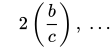
This tradition is, formally, in conflict with the note in algebra where adjacent symbols, without an explicit infix operator, denote a product. In the expression , the "understood" operation is multiplication. If x is replaced past, for example, the fraction , the "understood" multiplication needs to be replaced past explicit multiplication, to avoid the appearance of a mixed number.


When multiplication is intended, may exist written every bit

- or or


An improper fraction tin can be converted to a mixed number every bit follows:
- Using Euclidean sectionalization (sectionalization with residue), divide the numerator by the denominator. In the example, , divide 11 past iv. eleven ÷ four = 2 remainder 3.
- The quotient (without the residual) becomes the whole number part of the mixed number. The rest becomes the numerator of the partial function. In the example, 2 is the whole number function and three is the numerator of the partial part.
- The new denominator is the aforementioned as the denominator of the improper fraction. In the example, it is 4. Thus, .


Historical notions [edit]
Egyptian fraction [edit]
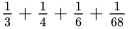
An Egyptian fraction is the sum of distinct positive unit of measurement fractions, for example . This definition derives from the fact that the ancient Egyptians expressed all fractions except , and in this manner. Every positive rational number can be expanded as an Egyptian fraction. For example, can be written as Any positive rational number tin be written equally a sum of unit fractions in infinitely many ways. Two ways to write are and .


Complex and compound fractions [edit]
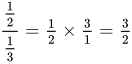
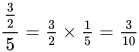
In a complex fraction, either the numerator, or the denominator, or both, is a fraction or a mixed number,[18] [19] corresponding to division of fractions. For example, and are complex fractions. To reduce a complex fraction to a uncomplicated fraction, treat the longest fraction line as representing division. For case:



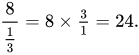
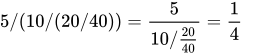
If, in a complex fraction, in that location is no unique style to tell which fraction lines takes precedence, and then this expression is improperly formed, because of ambivalence. So 5/x/20/40 is non a valid mathematical expression, because of multiple possible interpretations, e.g. as
- or as
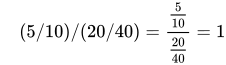
A compound fraction is a fraction of a fraction, or any number of fractions connected with the word of,[18] [nineteen] corresponding to multiplication of fractions. To reduce a compound fraction to a simple fraction, simply bear out the multiplication (come across the section on multiplication). For example, of is a compound fraction, corresponding to . The terms compound fraction and complex fraction are closely related and sometimes one is used as a synonym for the other. (For example, the chemical compound fraction is equivalent to the complex fraction .)


Nevertheless, "complex fraction" and "chemical compound fraction" may both exist considered outdated[20] and now used in no well-defined mode, partly even taken synonymously for each other[21] or for mixed numerals.[22] They have lost their meaning as technical terms and the attributes "circuitous" and "compound" tend to be used in their every day significant of "consisting of parts".
Arithmetic with fractions [edit]
Like whole numbers, fractions obey the commutative, associative, and distributive laws, and the rule against partitioning by zero.
Equivalent fractions [edit]
Multiplying the numerator and denominator of a fraction by the aforementioned (non-zero) number results in a fraction that is equivalent to the original fraction. This is true considering for any non-cypher number , the fraction equals . Therefore, multiplying by is the same as multiplying by one, and any number multiplied by one has the aforementioned value as the original number. By way of an instance, showtime with the fraction . When the numerator and denominator are both multiplied by 2, the effect is , which has the same value (0.5) equally . To picture this visually, imagine cutting a cake into four pieces; ii of the pieces together ( ) brand upwardly half the cake ( ).


Simplifying (reducing) fractions [edit]
Dividing the numerator and denominator of a fraction past the same non-zero number yields an equivalent fraction: if the numerator and the denominator of a fraction are both divisible past a number (called a factor) greater than 1, and so the fraction can be reduced to an equivalent fraction with a smaller numerator and a smaller denominator. For example, if both the numerator and the denominator of the fraction are divisible past so they tin can be written as and and the fraction becomes , which can exist reduced by dividing both the numerator and denominator by to give the reduced fraction


If i takes for c the greatest common divisor of the numerator and the denominator, one gets the equivalent fraction whose numerator and denominator have the lowest accented values. I says that the fraction has been reduced to its lowest terms.
If the numerator and the denominator do not share whatever factor greater than one, the fraction is already reduced to its lowest terms, and it is said to be irreducible, reduced, or in simplest terms. For example, is not in lowest terms considering both 3 and ix can be exactly divided by three. In contrast, is in lowest terms—the but positive integer that goes into both iii and 8 evenly is one.


Using these rules, nosotros can show that , for example.

As another example, since the greatest mutual divisor of 63 and 462 is 21, the fraction tin can be reduced to everyman terms by dividing the numerator and denominator past 21:


The Euclidean algorithm gives a method for finding the greatest common divisor of any two integers.
Comparing fractions [edit]
Comparing fractions with the same positive denominator yields the aforementioned event every bit comparing the numerators:
- considering iii > 2, and the equal denominators are positive.


If the equal denominators are negative, then the opposite result of comparing the numerators holds for the fractions:

If two positive fractions have the same numerator, then the fraction with the smaller denominator is the larger number. When a whole is divided into equal pieces, if fewer equal pieces are needed to make upward the whole, and then each slice must be larger. When two positive fractions accept the aforementioned numerator, they stand for the same number of parts, but in the fraction with the smaller denominator, the parts are larger.
One way to compare fractions with different numerators and denominators is to find a common denominator. To compare and , these are converted to and (where the dot signifies multiplication and is an alternative symbol to ×). And so bd is a mutual denominator and the numerators ad and bc tin can be compared. Information technology is not necessary to make up one's mind the value of the mutual denominator to compare fractions – one can simply compare ad and bc, without evaluating bd, due east.chiliad., comparing ? gives .


For the more laborious question ? multiply top and lesser of each fraction by the denominator of the other fraction, to become a common denominator, yielding ? . It is non necessary to calculate – just the numerators need to exist compared. Since 5×17 (= 85) is greater than 4×xviii (= 72), the result of comparing is .


Because every negative number, including negative fractions, is less than zero, and every positive number, including positive fractions, is greater than zero, information technology follows that any negative fraction is less than any positive fraction. This allows, together with the higher up rules, to compare all possible fractions.
Addition [edit]
The kickoff rule of addition is that simply similar quantities can exist added; for case, various quantities of quarters. Unlike quantities, such as adding thirds to quarters, must first be converted to like quantities as described below: Imagine a pocket containing two quarters, and another pocket containing three quarters; in total, in that location are five quarters. Since 4 quarters is equivalent to one (dollar), this can be represented as follows:
- .
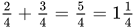
If of a block is to be added to of a cake, the pieces need to be converted into comparable quantities, such as cake-eighths or block-quarters.

Adding unlike quantities [edit]
To add fractions containing different quantities (eastward.grand. quarters and thirds), it is necessary to convert all amounts to similar quantities. It is easy to work out the chosen type of fraction to convert to; simply multiply together the 2 denominators (bottom number) of each fraction. In case of an integer number apply the invisible denominator

For calculation quarters to thirds, both types of fraction are converted to twelfths, thus:

Consider calculation the following two quantities:

Offset, convert into fifteenths by multiplying both the numerator and denominator by three: . Since equals i, multiplication by does not modify the value of the fraction.


2nd, catechumen into fifteenths past multiplying both the numerator and denominator by five: .

At present information technology can be seen that:
is equivalent to:
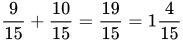
This method can be expressed algebraically:
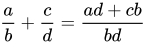
This algebraic method always works, thereby guaranteeing that the sum of simple fractions is always again a uncomplicated fraction. Even so, if the single denominators contain a mutual cistron, a smaller denominator than the product of these can be used. For case, when calculation and the single denominators have a common cistron and therefore, instead of the denominator 24 (4 × 6), the halved denominator 12 may exist used, not only reducing the denominator in the consequence, but also the factors in the numerator.


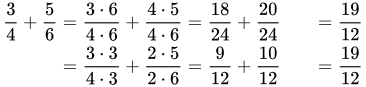
The smallest possible denominator is given by the least mutual multiple of the single denominators, which results from dividing the rote multiple past all common factors of the single denominators. This is called the least common denominator.
Subtraction [edit]
The process for subtracting fractions is, in essence, the same as that of adding them: find a common denominator, and change each fraction to an equivalent fraction with the called common denominator. The resulting fraction volition have that denominator, and its numerator will be the result of subtracting the numerators of the original fractions. For example,

Multiplication [edit]
Multiplying a fraction by another fraction [edit]
To multiply fractions, multiply the numerators and multiply the denominators. Thus:
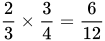
To explain the process, consider one 3rd of one quarter. Using the example of a block, if three small slices of equal size make upward a quarter, and four quarters make up a whole, twelve of these small, equal slices brand upwards a whole. Therefore, a 3rd of a quarter is a twelfth. Now consider the numerators. The starting time fraction, ii thirds, is twice as large as one third. Since 1 third of a quarter is 1 twelfth, two thirds of a quarter is two twelfth. The 2d fraction, three quarters, is three times every bit big as 1 quarter, so two thirds of three quarters is three times as large as two thirds of one quarter. Thus two thirds times three quarters is six twelfths.
A brusque cut for multiplying fractions is called "cancellation". Finer the reply is reduced to lowest terms during multiplication. For example:

A 2 is a common cistron in both the numerator of the left fraction and the denominator of the correct and is divided out of both. Three is a common factor of the left denominator and correct numerator and is divided out of both.
Multiplying a fraction by a whole number [edit]
Since a whole number can be rewritten as itself divided by 1, normal fraction multiplication rules can still apply.

This method works because the fraction six/1 means six equal parts, each one of which is a whole.
Multiplying mixed numbers [edit]
When multiplying mixed numbers, it is considered preferable to catechumen the mixed number into an improper fraction.[23] For instance:

In other words, is the aforementioned equally , making eleven quarters in total (considering 2 cakes, each divide into quarters makes eight quarters total) and 33 quarters is , since eight cakes, each fabricated of quarters, is 32 quarters in total.


Division [edit]
To separate a fraction by a whole number, you may either dissever the numerator by the number, if information technology goes evenly into the numerator, or multiply the denominator by the number. For example, equals and also equals , which reduces to . To divide a number by a fraction, multiply that number by the reciprocal of that fraction. Thus, .



Converting between decimals and fractions [edit]
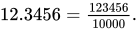
To change a common fraction to a decimal, do a long division of the decimal representations of the numerator by the denominator (this is idiomatically also phrased as "split the denominator into the numerator"), and circular the answer to the desired accuracy. For instance, to change ane / 4 to a decimal, dissever i.00 by four (" iv into 1.00"), to obtain 0.25. To modify 1 / 3 to a decimal, divide i.000... by 3 (" 3 into 1.000..."), and stop when the desired accuracy is obtained, e.g., at 4 decimals with 0.3333. The fraction 1 / 4 tin can be written exactly with 2 decimal digits, while the fraction 1 / three cannot be written exactly equally a decimal with a finite number of digits. To change a decimal to a fraction, write in the denominator a 1 followed by every bit many zeroes as at that place are digits to the right of the decimal indicate, and write in the numerator all the digits of the original decimal, just omitting the decimal point. Thus
Converting repeating decimals to fractions [edit]
Decimal numbers, while arguably more useful to work with when performing calculations, sometimes lack the precision that mutual fractions accept. Sometimes an infinite repeating decimal is required to reach the same precision. Thus, it is oft useful to catechumen repeating decimals into fractions.
A conventional way to indicate a repeating decimal is to identify a bar (known every bit a vinculum) over the digits that repeat, for example 0.789 = 0.789789789... For repeating patterns that begin immediately afterwards the decimal point, the consequence of the conversion is the fraction with the pattern as a numerator, and the same number of nines every bit a denominator. For case:
- 0.v = v/9
- 0.62 = 62/99
- 0.264 = 264/999
- 0.6291 = 6291/9999
If leading zeros precede the design, the nines are suffixed by the same number of trailing zeros:
- 0.05 = five/90
- 0.000392 = 392/999000
- 0.0012 = 12/9900
If a non-repeating prepare of decimals precede the pattern (such as 0.1523987), one may write the number equally the sum of the not-repeating and repeating parts, respectively:
- 0.1523 + 0.0000987
And so, catechumen both parts to fractions, and add together them using the methods described in a higher place:
- 1523 / 10000 + 987 / 9990000 = 1522464 / 9990000
Alternatively, algebra tin can be used, such every bit below:
- Let ten = the repeating decimal:
- x = 0.1523987
- Multiply both sides by the power of 10 just corking enough (in this case x4) to movement the decimal point but before the repeating part of the decimal number:
- x,000x = one,523.987
- Multiply both sides by the power of 10 (in this case 103) that is the aforementioned as the number of places that repeat:
- ten,000,000ten = i,523,987.987
- Subtract the two equations from each other (if a = b and c = d, then a − c = b − d):
- 10,000,000x − 10,000x = one,523,987.987 − 1,523.987
- Continue the subtraction operation to clear the repeating decimal:
- 9,990,000ten = 1,523,987 − 1,523
- ix,990,000x = 1,522,464
- Divide both sides past 9,990,000 to correspond x every bit a fraction
- x = 1522464 / 9990000
Fractions in abstract mathematics [edit]
In addition to being of not bad practical importance, fractions are also studied by mathematicians, who check that the rules for fractions given higher up are consequent and reliable. Mathematicians ascertain a fraction as an ordered pair of integers and for which the operations addition, subtraction, multiplication, and sectionalization are defined as follows:[24]






These definitions hold in every instance with the definitions given above; but the notation is dissimilar. Alternatively, instead of defining subtraction and sectionalisation as operations, the "inverse" fractions with respect to add-on and multiplication might be divers as:

Furthermore, the relation, specified as

is an equivalence relation of fractions. Each fraction from i equivalence class may exist considered as a representative for the whole class, and each whole class may be considered as i abstruse fraction. This equivalence is preserved past the to a higher place defined operations, i.e., the results of operating on fractions are independent of the selection of representatives from their equivalence grade. Formally, for addition of fractions
- and imply



and similarly for the other operations.
In the case of fractions of integers, the fractions a / b with a and b coprime and b > 0 are often taken every bit uniquely determined representatives for their equivalent fractions, which are considered to be the same rational number. This style the fractions of integers make upwardly the field of the rational numbers.
More generally, a and b may be elements of any integral domain R, in which example a fraction is an chemical element of the field of fractions of R. For example, polynomials in one indeterminate, with coefficients from some integral domain D, are themselves an integral domain, phone call it P. And then for a and b elements of P, the generated field of fractions is the field of rational fractions (likewise known as the field of rational functions).
Algebraic fractions [edit]
An algebraic fraction is the indicated quotient of ii algebraic expressions. Equally with fractions of integers, the denominator of an algebraic fraction cannot exist zero. Ii examples of algebraic fractions are and . Algebraic fractions are subject to the same field properties as arithmetic fractions.
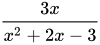

If the numerator and the denominator are polynomials, every bit in , the algebraic fraction is chosen a rational fraction (or rational expression). An irrational fraction is i that is not rational, every bit, for example, 1 that contains the variable under a partial exponent or root, as in .
The terminology used to describe algebraic fractions is similar to that used for ordinary fractions. For example, an algebraic fraction is in lowest terms if the only factors common to the numerator and the denominator are 1 and −1. An algebraic fraction whose numerator or denominator, or both, contain a fraction, such as , is called a complex fraction.

The field of rational numbers is the field of fractions of the integers, while the integers themselves are non a field but rather an integral domain. Similarly, the rational fractions with coefficients in a field course the field of fractions of polynomials with coefficient in that field. Considering the rational fractions with existent coefficients, radical expressions representing numbers, such as are likewise rational fractions, as are a transcendental numbers such equally since all of and are real numbers, and thus considered as coefficients. These aforementioned numbers, nevertheless, are non rational fractions with integer coefficients.


The term partial fraction is used when decomposing rational fractions into sums of simpler fractions. For instance, the rational fraction tin be decomposed as the sum of two fractions: This is useful for the computation of antiderivatives of rational functions (see partial fraction decomposition for more).


Radical expressions [edit]
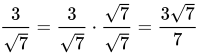
A fraction may also contain radicals in the numerator or the denominator. If the denominator contains radicals, information technology tin can be helpful to rationalize it (compare Simplified form of a radical expression), especially if further operations, such as calculation or comparing that fraction to another, are to exist carried out. It is also more convenient if division is to be done manually. When the denominator is a monomial square root, it tin can exist rationalized past multiplying both the elevation and the bottom of the fraction by the denominator:
The process of rationalization of binomial denominators involves multiplying the top and the bottom of a fraction by the conjugate of the denominator and then that the denominator becomes a rational number. For instance:


Fifty-fifty if this process results in the numerator beingness irrational, like in the examples above, the process may however facilitate subsequent manipulations by reducing the number of irrationals one has to piece of work with in the denominator.
Typographical variations [edit]
In computer displays and typography, elementary fractions are sometimes printed as a single character, e.chiliad. ½ (one half). See the article on Number Forms for information on doing this in Unicode.
Scientific publishing distinguishes 4 means to set fractions, together with guidelines on use:[25]
- Special fractions: fractions that are presented as a single character with a slanted bar, with roughly the same top and width every bit other characters in the text. Generally used for simple fractions, such as: ½, ⅓, ⅔, ¼, and ¾. Since the numerals are smaller, legibility can exist an issue, especially for small-sized fonts. These are not used in modern mathematical notation, but in other contexts.
- Example fractions: similar to special fractions, these are rendered every bit a single typographical graphic symbol, merely with a horizontal bar, thus making them upright. An instance would be , only rendered with the same height as other characters. Some sources include all rendering of fractions as case fractions if they accept merely one typographical space, regardless of the direction of the bar.[26]
- Shilling or solidus fractions: ane/2, so called because this notation was used for pre-decimal British currency (£sd), as in "ii/6" for a half crown, meaning two shillings and six pence. While the notation "two shillings and six pence" did not represent a fraction, the forward slash is at present used in fractions, especially for fractions inline with prose (rather than displayed), to avoid uneven lines. It is too used for fractions inside fractions (complex fractions) or inside exponents to increase legibility. Fractions written this way, also known as piece fractions,[27] are written all on 1 typographical line, merely take 3 or more typographical spaces.
- Built-upward fractions: . This annotation uses 2 or more than lines of ordinary text and results in a variation in spacing between lines when included within other text. While large and legible, these can exist disruptive, particularly for simple fractions or inside complex fractions.

History [edit]
The earliest fractions were reciprocals of integers: ancient symbols representing one part of two, one office of three, one function of 4, and so on.[28] The Egyptians used Egyptian fractions c. k BC. Virtually 4000 years agone, Egyptians divided with fractions using slightly different methods. They used least common multiples with unit fractions. Their methods gave the same answer as modern methods.[29] The Egyptians besides had a different notation for dyadic fractions in the Akhmim Wooden Tablet and several Rhind Mathematical Papyrus problems.
The Greeks used unit of measurement fractions and (later) continued fractions. Followers of the Greek philosopher Pythagoras (c. 530 BC) discovered that the square root of two cannot exist expressed as a fraction of integers. (This is commonly though probably erroneously ascribed to Hippasus of Metapontum, who is said to have been executed for revealing this fact.) In 150 BC Jain mathematicians in India wrote the "Sthananga Sutra", which contains work on the theory of numbers, arithmetical operations, and operations with fractions.
A mod expression of fractions known as bhinnarasi seems to have originated in Bharat in the work of Aryabhatta (c. Advert 500),[ citation needed ] Brahmagupta (c. 628), and Bhaskara (c. 1150).[30] Their works class fractions by placing the numerators (Sanskrit: amsa) over the denominators ( cheda ), simply without a bar betwixt them.[30] In Sanskrit literature, fractions were always expressed as an addition to or subtraction from an integer.[ citation needed ] The integer was written on 1 line and the fraction in its two parts on the next line. If the fraction was marked by a minor circle ⟨०⟩ or cross ⟨+⟩, information technology is subtracted from the integer; if no such sign appears, it is understood to be added. For case, Bhaskara I writes:[31]
- ६ १ २
- १ १ १०
- ४ ५ ९
which is the equivalent of
- vi 1 2
- i 1 −ane
- four 5 9
and would be written in modern notation equally vi 1 / four , 1 1 / 5 , and 2 − 1 / nine (i.e., 1 8 / nine ).
The horizontal fraction bar is first attested in the work of Al-Hassār (fl. 1200),[30] a Muslim mathematician from Fez, Morocco, who specialized in Islamic inheritance jurisprudence. In his word he writes: "for case, if y'all are told to write three-fifths and a third of a 5th, write thus, ". [32] The same partial notation—with the fraction given before the integer[xxx]—appears soon after in the work of Leonardo Fibonacci in the 13th century.[33]

In discussing the origins of decimal fractions, Dirk Jan Struik states:[34]
The introduction of decimal fractions as a mutual computational practice can be dated back to the Flemish pamphlet De Thiende, published at Leyden in 1585, together with a French translation, La Disme, past the Flemish mathematician Simon Stevin (1548–1620), then settled in the Northern Netherlands. Information technology is true that decimal fractions were used past the Chinese many centuries earlier Stevin and that the Persian astronomer Al-Kāshī used both decimal and sexagesimal fractions with bully ease in his Key to arithmetic (Samarkand, early fifteenth century).[35]
While the Persian mathematician Jamshīd al-Kāshī claimed to accept discovered decimal fractions himself in the 15th century, J. Lennart Berggren notes that he was mistaken, as decimal fractions were first used five centuries earlier him by the Baghdadi mathematician Abu'l-Hasan al-Uqlidisi every bit early as the 10th century.[36] [n 2]
In formal education [edit]
Pedagogical tools [edit]
In primary schools, fractions accept been demonstrated through Cuisenaire rods, Fraction Bars, fraction strips, fraction circles, paper (for folding or cutting), design blocks, pie-shaped pieces, plastic rectangles, grid paper, dot newspaper, geoboards, counters and estimator software.
Documents for teachers [edit]
Several states in the Us have adopted learning trajectories from the Common Core Land Standards Initiative's guidelines for mathematics educational activity. Aside from sequencing the learning of fractions and operations with fractions, the certificate provides the following definition of a fraction: "A number expressible in the form / where is a whole number and is a positive whole number. (The give-and-take fraction in these standards always refers to a non-negative number.)"[38] The document itself also refers to negative fractions.

See likewise [edit]
- Cross multiplication
- 0.999...
- Multiple
- FRACTRAN
| Complex |
|


Notes [edit]
- ^ Some typographers such every bit Bringhurst mistakenly distinguish the slash ⟨/⟩ as the virgule and the fraction slash ⟨⁄⟩ every bit the solidus,[six] although in fact both are synonyms for the standard slash.[vii] [8]
- ^ While there is some disagreement among history of mathematics scholars every bit to the primacy of al-Uqlidisi's contribution, there is no question as to his major contribution to the concept of decimal fractions.[37]
References [edit]
- ^ H. Wu, "The Mis-Teaching of Mathematics Teachers", Notices of the American Mathematical Society, Volume 58, Issue 03 (March 2011), p. 374. Archived 2017-08-xx at the Wayback Machine.
- ^ Schwartzman, Steven (1994). The Words of Mathematics: An Etymological Lexicon of Mathematical Terms Used in English . Mathematical Association of America. ISBN978-0-88385-511-9.
- ^ "Fractions". www.mathsisfun.com . Retrieved 2020-08-27 .
- ^ a b Ambrose, Gavin; et al. (2006). The Fundamentals of Typography (2nd ed.). Lausanne: AVA Publishing. p. 74. ISBN978-ii-940411-76-4. Archived from the original on 2016-03-04. Retrieved 2016-02-twenty . .
- ^ Weisstein, Eric West. "Fraction". mathworld.wolfram.com . Retrieved 2020-08-27 .
- ^ Bringhurst, Robert (2002). "five.2.5: Use the Virgule with Words and Dates, the Solidus with Split-level Fractions". The Elements of Typographic Style (3rd ed.). Indicate Roberts: Hartley & Marks. pp. 81–82. ISBN978-0-88179-206-5.
- ^ "virgule, n.". Oxford English language Dictionary (1st ed.). Oxford: Oxford University Press. 1917.
- ^ "solidus, northward.1 ". Oxford English Dictionary (1st ed.). Oxford: Oxford University Press. 1913.
- ^ Weisstein, Eric West. "Common Fraction". MathWorld.
- ^ a b David East. Smith (1 June 1958). History of Mathematics. Courier Corporation. p. 219. ISBN978-0-486-20430-7.
- ^ "World Wide Words: Vulgar fractions". Globe Wide Words. Archived from the original on 2014-ten-30. Retrieved 2014-ten-30 .
- ^ Weisstein, Eric W. "Improper Fraction". MathWorld.
- ^ Jack Williams (xix November 2011). Robert Recorde: Tudor Polymath, Expositor and Practitioner of Computation. Springer Science & Concern Media. pp. 87–. ISBN978-0-85729-862-1.
- ^ Record, Robert (1654). Tape's Arithmetick: Or, the Ground of Arts: Education the Perfect Work and Exercise of Arithmetick ... Made by Mr. Robert Record ... Afterward Augmented by Mr. John Dee. And Since Enlarged with a Third Role of Rules of Practise ... By John Mellis. And Now Diligently Perused, Corrected ... and Enlarged ; with an Appendix of Figurative Numbers ... with Tables of Lath and Timber Measure ... the First Calculated past R. C. Only Corrected, and the Latter ... Calculated by Ro. Hartwell ... James Flesher, and are to be sold past Edward Dod. pp. 266–.
- ^ Laurel (31 March 2004). "Math Forum – Enquire Dr. Math: Can Negative Fractions Likewise Be Proper or Improper?". Archived from the original on 9 November 2014. Retrieved 2014-x-xxx .
- ^ "New England Meaty Math Resource". Archived from the original on 2012-04-15. Retrieved 2011-12-31 .
- ^ Greer, A. (1986). New comprehensive mathematics for 'O' level (2nd ed., reprinted ed.). Cheltenham: Thornes. p. 5. ISBN978-0-85950-159-0. Archived from the original on 2019-01-19. Retrieved 2014-07-29 .
- ^ a b Trotter, James (1853). A complete system of arithmetic. p. 65.
- ^ a b Barlow, Peter (1814). A new mathematical and philosophical lexicon.
- ^ "complex fraction". Collins English language Lexicon. Archived from the original on 2017-12-01. Retrieved 29 August 2022.
- ^ "Complex fraction definition and meaning". Collins English Dictionary. 2018-03-09. Archived from the original on 2017-12-01. Retrieved 2018-03-13 .
- ^ "Chemical compound Fractions". Sosmath.com. 1996-02-05. Archived from the original on 2018-03-fourteen. Retrieved 2018-03-13 .
- ^ Schoenborn, Barry; Simkins, Bradley (2010). "8. Fun with Fractions". Technical Math For Dummies. Hoboken: Wiley Publishing Inc. p. 120. ISBN978-0-470-59874-0. OCLC 719886424. Retrieved 28 September 2020.
- ^ "Fraction". Encyclopedia of Mathematics. 2012-04-06. Archived from the original on 2014-10-21. Retrieved 2012-08-15 .
- ^ Galen, Leslie Blackwell (March 2004). "Putting Fractions in Their Identify" (PDF). American Mathematical Monthly. 111 (3): 238–242. doi:x.2307/4145131. JSTOR 4145131. Archived (PDF) from the original on 2011-07-13. Retrieved 2010-01-27 .
- ^ "built fraction". allbusiness.com glossary. Archived from the original on 2013-05-26. Retrieved 2013-06-18 .
- ^ "piece fraction". allbusiness.com glossary. Archived from the original on 2013-05-21. Retrieved 2013-06-18 .
- ^ Eves, Howard (1990). An introduction to the history of mathematics (6th ed.). Philadelphia: Saunders College Pub. ISBN978-0-03-029558-4.
- ^ Milo Gardner (December nineteen, 2005). "Math History". Archived from the original on December nineteen, 2005. Retrieved 2006-01-eighteen . See for examples and an explanation.
- ^ a b c d Miller, Jeff (22 December 2014). "Earliest Uses of Various Mathematical Symbols". Archived from the original on 20 February 2016. Retrieved 15 Feb 2016.
- ^ Filliozat, Pierre-Sylvain (2004). "Ancient Sanskrit Mathematics: An Oral Tradition and a Written Literature". In Chemla, Karine; Cohen, Robert S.; Renn, Jürgen; et al. (eds.). History of Scientific discipline, History of Text. Boston Series in the Philosophy of Science. Vol. 238. Dordrecht: Springer Netherlands. p. 152. doi:10.1007/1-4020-2321-9_7. ISBN978-1-4020-2320-0.
- ^ Cajori, Florian (1928). A History of Mathematical Notations. Vol. 1. La Salle, Illinois: Open up Courtroom Publishing Visitor. p. 269. Archived from the original on 2014-04-14. Retrieved 2017-08-30 .
- ^ Cajori (1928), p. 89
- ^ A Source Book in Mathematics 1200–1800. New Bailiwick of jersey: Princeton University Press. 1986. ISBN978-0-691-02397-7.
- ^ Die Rechenkunst bei Ğamšīd b. Mas'ūd al-Kāšī. Wiesbaden: Steiner. 1951.
- ^ Berggren, J. Lennart (2007). "Mathematics in Medieval Islam". The Mathematics of Arab republic of egypt, Mesopotamia, China, India, and Islam: A Sourcebook. Princeton University Press. p. 518. ISBN978-0-691-11485-9.
- ^ "MacTutor's al-Uqlidisi biography". Archived 2011-11-fifteen at the Wayback Auto. Retrieved 2011-eleven-22.
- ^ "Common Core State Standards for Mathematics" (PDF). Common Core State Standards Initiative. 2010. p. 85. Archived (PDF) from the original on 2013-10-19. Retrieved 2013-10-10 .
External links [edit]

Wikimedia Commons has media related to Fractions.

Look up denominator in Wiktionary, the free dictionary.
Wait up numerator in Wiktionary, the free dictionary.
- "Fraction, arithmetical". The Online Encyclopaedia of Mathematics.
- "Fraction". Encyclopædia Britannica.
- "Fraction (mathematics)". Citizendium.
- "Fraction". PlanetMath. Archived from the original on 25 October 2019. Retrieved 29 September 2019.

3.6 As A Improper Fraction,
Source: https://en.wikipedia.org/wiki/Fraction
Posted by: foxarned2000.blogspot.com
0 Response to "3.6 As A Improper Fraction"
Post a Comment