

Is 50 A Composite Number
In Mathematics, composite numbers are numbers that have more two factors. These numbers are likewise chosen composites. Composite numbers are just the opposite of prime number numbers which have only two factors, i.due east. ane and the number itself. All the natural numbers which are non prime numbers are composite numbers equally they tin exist divided by more than two numbers. For example, 6 is a blended number because it is divisible by ane, two, iii and fifty-fifty past six.In this article, we will learn the definition of composite numbers, properties, smallest composite number, even and odd blended numbers, list of composite numbers, and difference between prime number and blended numbers along with many solved examples in detail.
What are Composite Numbers in Maths?
Definition i: In Mathematics, blended numbers are numbers that have more than than two factors.
Definition 2: The numbers which can be generated by multiplying the ii smallest positive integers and comprise at least one divisor other than the number '1' and itself are known every bit composite numbers. These numbers always have more than two factors.
Fact: Any even number which is greater than two is a composite number .
Is 0 a Composite Number?
Zero (0) is considered as neither prime nor a composite number because it does not take any factors.
Composite Numbers Examples
The examples of blended numbers are 6, 14, 25, 30, 52, etc, such that:
| Composite numbers | Factors |
| 6 | 1, 2, 3, 6 |
| 14 | one, two, 7, 14 |
| 25 | one, 5, 25 |
| 30 | 1, 2, 3, 5, 6, 10, 15, thirty |
| 52 | 1, ii, 4, xiii, 26, 52 |
In all the above examples, we tin run across the blended numbers have more than 2 factors. There are a number of composite numbers we tin can list out of a ready of natural numbers from one to grand or more. Let u.s. see the listing of composite numbers in the next section.
Backdrop of Composite Numbers
The backdrop of composite numbers are easy to retrieve.
- Composite numbers accept more than 2 factors
- Blended numbers are evenly divisible by their factors
- Each composite number is a factor of itself
- The smallest composite number is iv
- Each composite number will include at least two prime numbers as its factors (Eg. x = 2 x 5, where 2 and five are prime number numbers)
- Composite numbers are divisible by other blended numbers also
List of Blended Numbers
Here is the listing of blended numbers from ane to 100 in Maths. Students can go on a note of this and also effort to write the numbers beyond 100 for exercise, such composites from ane to 200 or till 500.
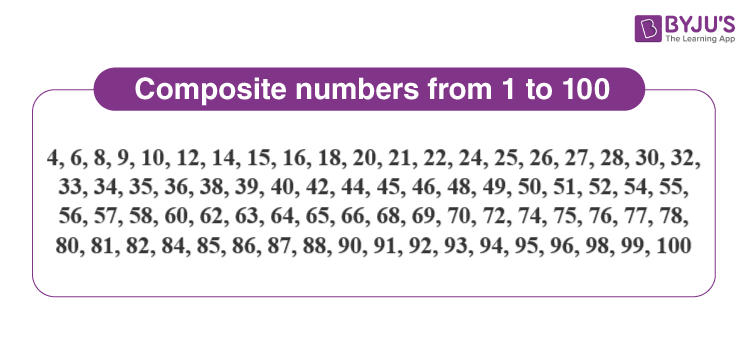
Composite Numbers Chart
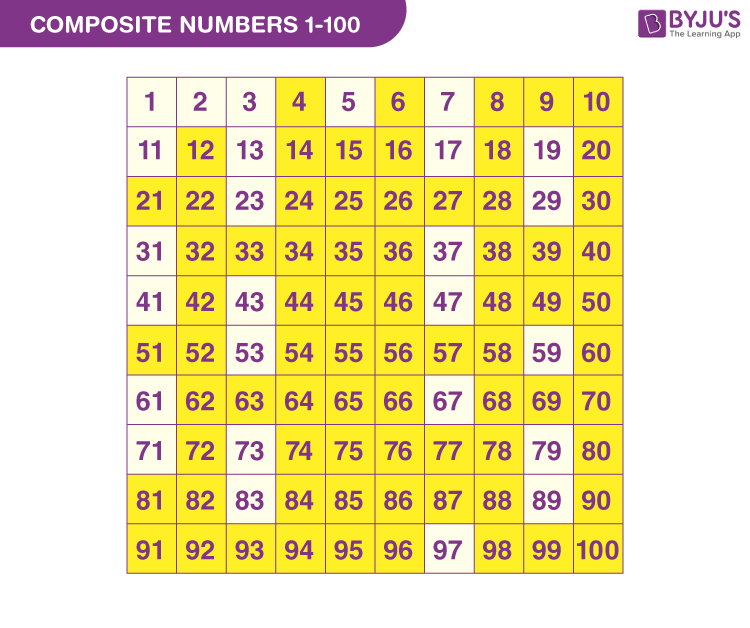
Blended Numbers one to 200
The positive integers having more than ii factors are composite numbers. The list of Composite numbers from 1 to 200 are given beneath in the table.
4, 6, 8, nine, 10, 12, 14, 15, sixteen, 18, 20, 21, 22, 24, 25, 26, 27, 28, xxx, 32, 33, 34, 35, 36, 38, 39, 40, 42, 44, 45, 46, 48, 49, 50, 51, 52, 54, 55, 56, 57, 58, 60, 62, 63, 64, 65, 66, 68, 69, 70, 72, 74, 75, 76, 77, 78, 80, 81, 82, 84, 85, 86, 87, 88, 90, 91, 92, 93, 94, 95, 96, 98, 99, 100, 102, 104, 105, 106, 108, 110, 111, 112, 114, 115, 116, 117, 118, 119, 120, 121, 122, 123, 124, 125, 126, 128, 129, 130, 132, 133, 134, 135, 136, 138, 140, 141, 142, 143, 144, 145, 146, 147, 148, 150, 152, 154, 155, 156, 157, 158, 159, 160, 162, 164, 165, 166, 168, 170, 172, 174, 175, 176, 177, 178, 180, 182, 184, 185, 186, 187, 188, 189, 190, 192, 194, 195, 196, and 198.
How to Find the Composite Number?
The procedures to notice whether a given number is prime or blended:
- Find all the factors of the positive integer
- A number is said to exist prime number if it has only two factors, 1 and itself
- If the number has more than than two factors, so it is a composite
- 14÷ane = 14
- 14÷2 = 7
- 14÷seven = 2
- xiv÷14 = 1
Equally we tin can see, the factors of 14 are 1,2,7 and xiv, so it is a blended number.
Types of Composite Numbers
In that location are two main types of composite numbers in Maths which are:
- Odd Composite Numbers or Composite Odd Numbers
- Even Blended Numbers or Composite Fifty-fifty Numbers
Odd Blended Numbers
All the odd integers which are not prime are odd composite numbers. Examples of composite odd numbers are nine, 15, 21, 25, 27, 31, etc.
Even Blended Numbers
All the fifty-fifty integers which are not prime are even composite numbers. Examples of even composite numbers are 4, six, 8, x, 12, 14, 16, etc.
Smallest Blended Number
four is the smallest blended number.
Why?
1 is not a composite number because the sole divisor of 1 is 1. The positive integers 2 and iii are prime number numbers because it can be divided by merely two factors, one and itself. Hence 2 and 3 are not composite.
But in the example of number four, we accept more than two factors. The divisors of 4 are one,ii,four. So this number satisfies the status of a blended number equally mentioned above. After 4, vi is the next blended positive integer, which has factors 1, 2, 3 and 6.
Hence, 4 is the smallest blended number (Proved).
- Smallest Composite Number = four
- Smallest Prime Number = 2
- Smallest Odd Composite Number = 9
- Ii-digit Smallest Composite Number = 10
Departure Between Prime and Composite Numbers
The difference between the prime numbers and the composite numbers in Maths are listed below:
| Prime Numbers | Composite Numbers |
|---|---|
| It can only be divided by i and itself, thus take only two factors. | It has more than than two factors (1 and itself). |
| Information technology can but be written as a product of two numbers | It can be written as the product of 2 or more numbers |
| Example: five has factors are 1 and 5 | Example: iv has factors are 1, two and 4 |
Prime Factorization of Composite Numbers
The list of composite numerals from i to 50 are given here with their prime number factorization. You can come across here how the composites are factorized in prime numbers. Check the below table to understand better. With the help of this table, you can also discover composites beyond l with their prime factorization.
| Composite Numbers | Prime Factorization |
| 4 | 2 × ii |
| half dozen | ii × 3 |
| viii | 2 × ii × 2 |
| ix | three × three |
| 10 | 2 × 5 |
| 12 | 2 × ii × 3 |
| fourteen | 2 × 7 |
| fifteen | three × five |
| xvi | 2 × ii × 2 × ii |
| eighteen | two × iii × 3 |
| 20 | two × 2 × 5 |
| 21 | iii × vii |
| 22 | 2 × 11 |
| 24 | ii × 2 × ii × iii |
| 25 | five × five |
| 26 | 2 × 13 |
| 27 | 3 × 3 × three |
| 28 | ii × 2 × seven |
| 30 | two × iii × 5 |
| 32 | 2 × two × two × 2 × 2 |
| 33 | 3 × 11 |
| 34 | 2 × 17 |
| 35 | 5 × vii |
| 36 | 2 × 2 × 3 × three |
| 38 | 2 × 19 |
| 39 | 3 × 13 |
| 40 | 2 × 2 × 2 × 5 |
| 42 | ii × 3 × seven |
| 44 | 2 × 2 × 11 |
| 45 | 3 × 3 × 5 |
| 46 | 2 × 23 |
| 48 | 2 × two × 2 × 2 × 3 |
| 49 | vii × seven |
| 50 | two × five × v |
Video Lesson on Numbers
Related Articles
- Prime and Blended Numbers
- Prime number Factorization
- Prime, Blended And Fifty-fifty, Odd Numbers
Solved Problems on Composite Numbers
Example 1:
Discover if 328 is a composite number.
Solution:
The factors of 328 are i, ii, iv, 8, 41, 82, 164, 328.
Therefore, 328 is a blended number.
Example 2:
What is the prime factorization of lx?
Solution:
The prime factorization of 60 is:
60 = two × 2 × 3 × 5.
Case three:
Listing out the composite numbers from the given set of numbers.
2, 4, 9, 11, 21, 31, 44, 53, 67, 88, 101, 108.
Solution:
The composite numbers are: 4, ix, 21, 44, 88, 108.
Instance 4:
Find the product of first 5 composite numbers.
Solution:
The first 5 composite numbers are 4, 6, 8, 9, 10.
Hence, the production of first 5 composite numbers = 4 × vi × 8 × 9 × 10
= 17280
Therefore, the product of first five composite numbers is 17280.
Practise Questions (Worksheet)
- List the composite numbers between xx and 30.
- Detect if 85 is a composite number.
- What are the prime factors of 99?
- What is the sum of factors of composite number 18?
- Find the composite numbers amongst the following set up of numbers in the given table.
| seven | 18 | 33 | 11 |
| half dozen | 13 | xc | 21 |
| 98 | 5 | 63 | 19 |
| 61 | 52 | ii | 81 |
To learn more most the different types of numbers, download BYJU'Due south -The Learning App from the Google play store and watch interactive videos.
Often Asked Questions on Composite Numbers
What is a composite number?
A composite number is a natural number or a positive integer which has more than ii factors. For instance, fifteen has factors 1, 3, five and 15, hence it is a composite number.
Is 2 a blended number?
No, 2 is non a composite number because information technology has only two factors, i.east. 1 and two. Hence, information technology is a prime number.
Is 9 a composite number?
Yes, 9 is a composite number because it has more than 2 factors, such as ane, iii and 9.
What are the composite numbers from ane to 100?
The listing of composite numbers from ane to 100 are:
4, 6, viii, 9, 10, 12, xiv, 15, 16, 18, 20, 21, 22, 24, 25, 26, 27, 28, 30, 32, 33, 34, 35, 36, 38, 39, twoscore, 42, 44, 45, 46, 48, 49, l, 51, 52, 54, 55, 56, 57, 58, 60, 62, 63, 64, 65, 66, 68, 69, 70, 72, 74, 75, 76, 77, 78, 80, 81,82, 84, 85, 86, 87, 88, 90, 91, 92, 93, 94, 95, 96, 98, 99, 100.
Is xix prime or composite?
19 is a prime number number because it has only 2 factors, i.eastward. 1 and 19.
Is 1 a composite number?
No, because 1 does not take more than ii factors instead it has only 1 cistron. Hence, information technology is neither prime nor blended.
How many composite numbers are at that place between 1 and x?
There are 4 blended numbers between 1 and 10. They are iv,6,eight and 9.
Is 49 a composite number?
Yes, 49 is a composite number, because it contains more than ii factors. The factors of 49 are one, 7 and 49.

Is 50 A Composite Number,
Source: https://byjus.com/maths/composite-numbers/
Posted by: foxarned2000.blogspot.com
0 Response to "Is 50 A Composite Number"
Post a Comment