

How To Say Aubrey In Spanish
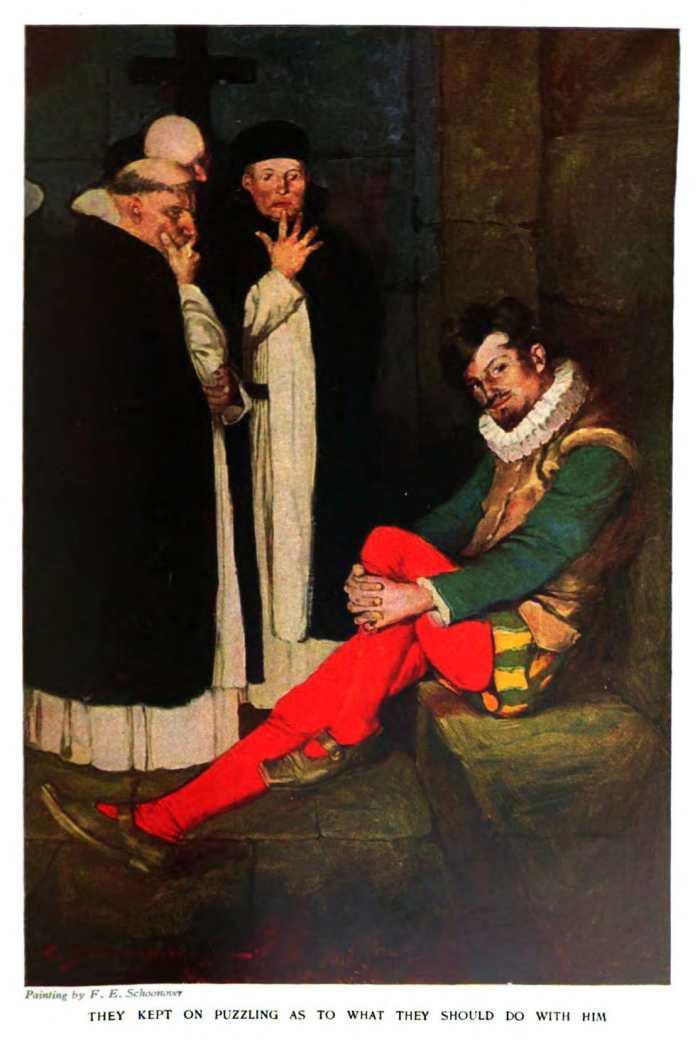
A 1908 supporting illustration of the mystery in an article for the Harper's Monthly Magazine.
It All Started With an Bump-off
In October of 1593, the seventh ruling Spanish governor-full general to the Philippines—Gomez Perez Dasmariñas y Ribadeniera—led a secret expedition to capture the fort of Ternate in the Indonesian island of Moluccas (now Maluku), where 2 previous Spanish expeditions take failed. Before he sailed, he sent his son alee with part of the fleet and left the colony under the accuse of ii other Spanish officials.
The entire fleet consisted of 200 various marine vessels and was accompanied by more than 900 Spaniards and over 250 conscripted Chinese galley rowers that were untrained in synchronized rowing and regularly flogged and starved. The governor'south send, named La Capitana, was manned by only well-nigh forty Spaniards and encountered strong headwinds that prevented them from proceeding further on the second 24-hour interval of their military trek.
While anchored on an island merely off the coast of Luzon, the Chinese men realized the grim fate that awaited them fighting a battle that was not their own. And so they decided that the all-time grade of action was mutiny, led by a human being named P'an Ho Wu. Before the early hours of dawn, when most of the guards were sleeping, the Chinese attacked the Spaniards and killed the governor with an axe to the head, leaving a few survivors to tell the tale.
But according to Spanish colonial official and historian Antonio de Morga, the Chinese rowers were unchained and were paid wages to win their sympathy. Some afterward accounts besides referred to them as Chinese pirates, which was not true. They were only regarded as pirates because they took the galley, along with all the valuables on board, when they were making their escape. The Chinese Emperor allegedly confiscated the items upon reaching Cochin-China (the present-mean solar day office of Vietnam), and some of the mutineers were captured in Malacca (Malaysia) and then brought back to Manila to face penalty.
The Sleeping Scout
When news of the old viceroy's murder came back in the Palacio del Gobernador in Manila, the Castilian authorities were divided in finding his successor. To foreclose uprisings from the colonized Filipinos while awaiting the decision, Spanish guards were stationed throughout the perimeter of Intramuros.
An initially unnamed lookout man was standing guard in the Plaza de Armas on the grounds of Fort Santiago, just exterior the governor'south palace that evening. Attributing it to work fatigue and tense political weather, he leaned his head against the thick wall to steal some much-needed sleep. When he opened his eyes a few moments later, he found himself in an unfamiliar location.
Afterward the Castilian conquest, the Philippines was ruled by a Mexico-based Viceroyalty of New Espana. Under the orders of conquistador Miguel Lopez de Legazpi, the fortified urban center of Intramuros (Latin for "within the walls") was built in 1571 to be the place of residence for Spanish government officials and their families and function as the Spaniard's political and military machine base in Asia. The site was originally office of a large Malayan Muslim settlement called Maynilad (now Manila), named afterward the abundance of a flowering water plant locally called nilad (yamstick mangrove) that amassed in the depression-lying riverbanks of the Pasig river.
Before moving the seat of ability to the Malacañang, the original structure of the governor's palace was destroyed past an earthquake on June 1863, now replaced by its current class, which was built in 1976. Near people also assumed that the soldier in the story belonged to the Guardia Civil—the oldest law enforcement agency in Spain. Merely this is wrong because they were only established in 1844 and introduced in the Philippines in 1868—275 years afterward the story supposedly took identify.
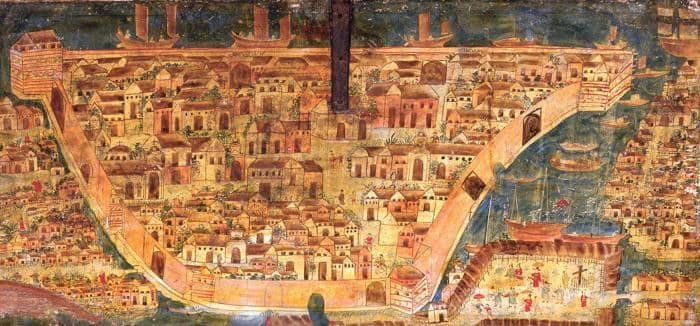
An oil painting of the walled urban center of Manila, circa 1640-1650 displayed in the Museo de Arte Jose Luis Bello in Puebla, Mexico.
Out of Place
The Castilian guard was confused every bit to what had simply happened. He asked bystanders where he was, and they told him that he is in the Plaza Mayor (commonly chosen El Zócalo) in the aboriginal city of United mexican states—well-nigh ix,000 miles away from the Philippines. Not knowing what else to exercise, he resumed his guard duties and stood outside the Palacio Imperial (the viceroy'due south palace) equally if he belonged at that place.
Other Castilian guards quickly noticed him because he stood out like a sore thumb. He was wearing a dissimilar type of uniform than they do, which during this time, could potentially invite war. When asked who he was and why he looks strange, he explained that his proper name is Gil Pérez, a royal guard of the Spanish Empire on patrol duty in Manila merely moments before.
In the pre-Columbian era, the Zócalo was the primary ceremonial center where the almost of import ritual activities in Aztec life took identify. The site is inside the metropolis of Tenochtitlan, merely i block southwest of the Templo Mayor, which, according to Aztec legend and mythology, was considered the promised state prophesized past their god Huitzilopochtli and symbolizes the Centrality Mundi—the Aztec center of the world, where the heaven, the earth, and the underworld met.
Nobody Believed Him
At first, they idea he was insane and escorted him for further questioning. He added some more details about himself, his rank, and his regiment and gave descriptions of the country he was stationed in and its people. Skeptical of the strange soldier'south claims, the Spanish authorities in Mexico threw him in jail on the grounds of desertion. To protest his innocence, Gil Perez told them that the governor-full general in the Philippines was just assassinated by Chinese mutineers before he was transported to Mexico City.
With such assuming fabrication about the governor's decease, he was brought to the Viceroy of New Kingdom of spain, Luis de Velasco y Ruiz de Alarcón. Although Perez was wearing the exact uniform worn by officers in the Philippines, he was withal unable to prove his claims. Unable to provide a verdict, the viceroy turned Perez over to the Office of the Holy Inquisition, where he was able to reply all their queries efficiently and stuck to his unbelievable account. The only thing he was not able to explain is how he traveled to United mexican states.
To no ane's surprise, Gil Perez was declared an agent of the devil and sent to exist imprisoned in Santo Domingo on the Caribbean island of Hispaniola. He cooperated with the High Inquisitors and generally displayed good conduct while incarcerated. Some say that Perez preferred to exist in jail, where provisions are given to him, than fight infidels in the jungles of the Philippines.
Confirmation Arrived
A few months later, a ship from Manila arrived in United mexican states City, confirming that Dasmariñas was indeed killed. Soon, in that location was no doubt that Gil Perez was from Manila, but they were still unable to understand how he managed to get there that fast. He was recalled back to Mexico, and ane of the passengers of the ship recognized him, stating that he had seen Perez in Manila earlier they departed. Because he was a devout Catholic, served in the military for twenty years, and committed no law-breaking, Gil Perez was later sent back to Manila on the returning voyage to resume his post in Intramuros.
A annotation expressing the murdered governor's instructions was later found in his body, wishing for his son Luis Perez Dasmariñas y Paez de Sotomayor to have over his father'due south position. He ruled for three years until he, similar his father before him, was too killed past Chinese rebels in the Sangley rebellion of 1603 later on his term as governor had ended.
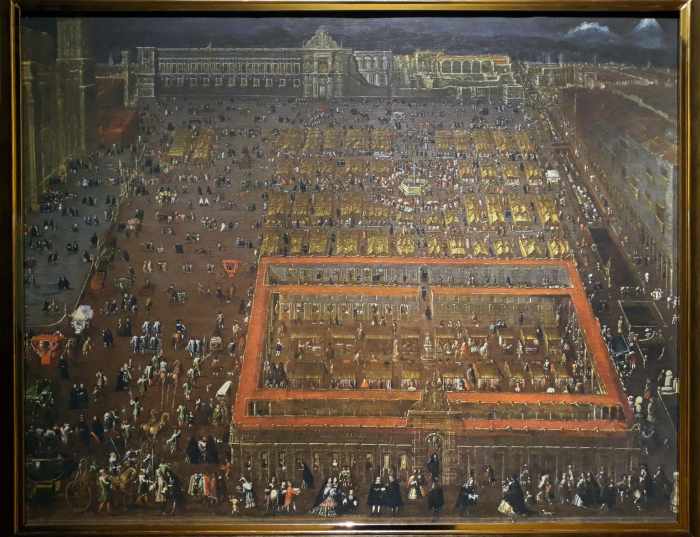
View of the Plaza Mayor of Mexico City c. 1695, painted by Cristóbal de Villalpando.
"It is worthy of consideration, that the same day that the tragedy of Gomez Perez happened, the fact was learned in Mexico past the art of Satan; from whom some women, inclined to such agility, having taken advantage, transplanted to the Plaza de Mexico a soldier who was making a post one night in a garrison of the wall of Manila, and it was executed and then without the Soldier feeling, that in the morning time they constitute him marching guard duty in the Plaza de Mexico, asking the name of passersby."
— Fray Gaspar de San Agustin, Conquistas de las Islas Filipinas, 1698, p. 465
And so Did It Really Happen?
The bump-off of Dasmariñas did happen, but the primeval actual mention of the transported soldier story was published in 1698 by Spanish clergyman and historian Gaspar de San Augustin in his book Conquests of the Philippine Islands. But the fact that it was published over a hundred years later on the event does not inspire conviction in its credibility.
Antonio de Morga is also one of the sources oftentimes cited for the story'due south actuality, in his book Sucesos de las Islas Filipinas (Events in the Philippine Islands), published in 1609—merely 16 years later the incident occurred. Just de Morga failed to mention any details and stated that "no one in United mexican states knew of the death of Governor Dasmariñas until discussion arrived by send thirteen months later on".
When de Morga'due south volume was reprinted in 1890, information technology featured copious amounts of annotations by Philippine national hero, Dr. Jose Rizal. Rizal had heard of the story from Gaspar de San Agustin and believed it to be fact. When he came to the part that did not include details, Rizal added an note that explained the story, as laid out by de San Augustin.
Morga, perhaps because he does non give credence to such facts, not simply does not mention them, but says more strictly later (p. 37), that the news was non known [in Mexico City] until D. Juan de Yelasco came for the month of November, 1594, that is, 13 months later.
Because Rizal was such a prominent figure not but in the Philippines but too in Espana, many people also took his word every bit fact.
Further Development
For more than 400 years, this story has been told and retold multiple times by diverse writers and authors. The Spanish soldier remained nameless until American folklorist Thomas Allibone Janvier wrote virtually it in the 1908 edition of Harper's Mag under the title Fable of the Living Spectre. Janvier based his accounts on a Spanish version of the fable written by Mexican folklorist Luis Gonzales Obregon, who, likewise traced it back to de San Agustin'south.
Conflicting Dates
At least 3 dates are beingness considered for Dasmariñas' death: Oct 19, 23, and 25. The last one is the most normally accepted date past historians. After renditions of the story state that the soldier reappeared in Mexico City on the 24th of Oct that twelvemonth. If that's the instance, information technology would make him not just a teleporter only likewise a seer if the governor was indeed killed on the 25th.
In the 16th century, the galleon trade between Manila and Acapulco made one or ii circular-trip voyages per twelvemonth. They usually left the Phillippines in June before the typhoon season began, and the journey would have taken at to the lowest degree five to six months before reaching Mexico.
Provided Dasmariñas died in Oct, the corroboration past the galleon passengers might exist thrown into uncertainty equally well because they must non have known most the governor-general'south death if they left the Philippines post-obit the usual schedule. And it would have taken them 17 months to get in in Mexico in November of the next yr, not xiii months subsequently equally suggested by de Morga and Rizal.
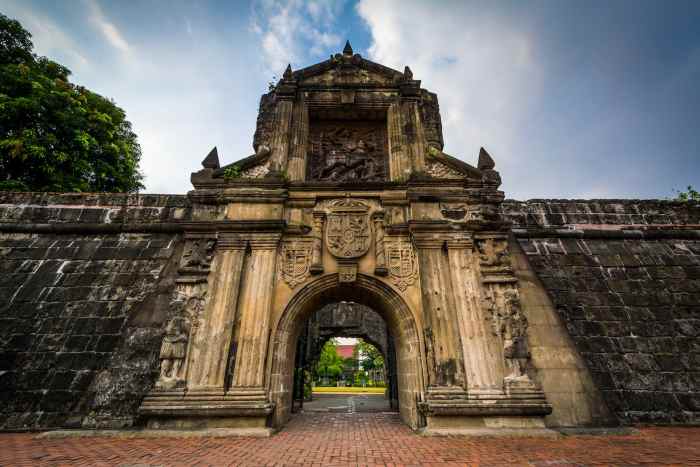
Could these walls allow teleportation? The archway to Fort Santiago in Intramuros.
Proposed Theories
For the 16th-century Spanish Inquisition, Gil Perez was a tool of the witches and the devil. Today, many believers in the fable suggest both mundane and farfetched ideas that reflect our modern beliefs and understanding.
Alien Abduction
The eighth Earl of Clancarty and notable proponent of the Hollow Earth Theory, William Francis Brinsley Le Poer Trench, suggest that Gil Perez was likely abducted past subterranean humanoids that originated in space (referred to as The Greys past Ancient Astronaut Theorists) and living in thriving civilizations underneath our feet.
Another ufologist past the proper noun of Morris Grand. Jessup, famous for his 1955 book The Case for the UFO, included the story as an example of transportation by a arts and crafts of unknown origins. He claims his authorization for the integrity of the business relationship by stating:
"A Legend? Not according to the records of the chroniclers of the Guild of San Augustin and the order of Santo Domingo. Not according to Dr. Antonio de Morga, high justice of the criminal court of the Royal Audiencia of New Spain, in his 'Sucesos exercise las Islas Filipinas."
The mysterious case is likewise compared to a 1696 volume titled Miscellanies by antique and natural philosopher John Aubrey. In a chapter well-nigh Transportation in the Air, Aubrey recounts a story of a man from Eastern Republic of india who was transported to Goa (Portugal) and burned at the stake by the Inquisition.
But could this exist merely another version of the legend similar the ane written by Artemio de Valle Arizpe entitled "Por el aire vino, por la mar se fue" ("He came by air, he left by body of water") included in a 1936 drove of Mexican folklore?
Teleportation
The most popular stance near the story is spontaneous teleportation—the hypothetical transfer of affair or energy from ane point to some other without traversing the concrete altitude between them. Now, human teleportation as displayed in works of science fiction remains an exotic idea. Simply scientists have managed to successfully "teleport" data, not thing.
Chinese researchers take reached the longest distance recorded so far when they sent information on a photon (light particle) from Globe to an orbiting satellite in space 870 miles away using the miracle chosen quantum entanglement (which Einstein calls "chilling activity at a altitude"). The piece of work started in 1997 and gradually increased in distance throughout the years.
Some other theory about what happened to Gil Perez was the being of a wormhole that connects Intramuros to the Zocalo. Both places are considered energetically condensed, which could result in them being function of a global network of energy centers chosen Ley lines. But this theory is weak, considering that wormholes could merely exist theoretically produced if two black holes exist in the infinite-time continuum.
Fugue States
If Gil Perez was indeed a real historical person, the most possible explanation for what happened to him is temporary amnesia. Dissociative fugue is a symptom of a mental disorder triggered by high-stress or traumatic experiences. This condition is portrayed properly in the Marvel series Moon Knight.
As a soldier for the Spanish crown, Perez fought endless wars and was given orders to guard a colonial location placed on heightened alarm that night. He could have easily slipped into a fugue country, was ordered to get to Mexico City to evangelize the news, and came out not remembering how he got at that place, thinking information technology was still the same day.
Philippines and Mexico
Apart from this fable existence shared by United mexican states and the Philippines, both countries were colonized by Espana and have had shared traditions and culture since so. Mexicans gave Filipinos their version of the celebration of the Day of the Dead, too as several gastronomic influences. Some may even refer to Filipinos as the Mexicans of Asia. As a Filipino myself, I have that as a compliment.
Whether it is true or not, the story of Gil Perez is a long-standing mystery that captured the curiosity of many.
© 2022 Ian Fasten
Source: https://exemplore.com/legends/Did-a-Man-Successfully-Teleport-From-Manila-to-Mexico-in-1593
0 Response to "How To Say Aubrey In Spanish"
Post a Comment